| 赞 | 120 |
| VIP | |
| 好人卡 | |
| 积分 | 194 |
| 经验 | |
| 最后登录 | 2026-7-4 |
| 在线时间 | 3082 小时 |
- 梦石
- 0
- 星屑
- 19426
- 在线时间
- 3082 小时
- 注册时间
- 2013-1-11
- 回帖
- 1207
|
加入我们,或者,欢迎回来。
您需要 登录 才可以下载或查看,没有账号?注册会员
×
本帖最后由 张咚咚 于 2022-1-22 12:02 编辑
脚本内容- #encoding:utf-8
- #==============================================================================
- # ■ 定时器v3.0 By_QQEat ————2022.01.16
- #
- # 说明:定时执行脚本, tween 动画等。
- #
- # [创建、释放等基础方法]
- #
- # @timer = Timer.new # 创建
- # @timer.update(tag=nil) # 更新(传标签参数后, 则只更新指定标签的任务)
- # @timer.dispose # 释放
- # @timer.disposed? # 是否已释放?
- # @timer.clear # 清空计时任务
- # @timer.timer # 查看所有任务
- #
- # [添加任务]
- #
- # @timer.cancel(*tags) # 删除定时任务(支持正则表达式)
- # @timer.after(delay, action, tag=nil)
- # @timer.every(delay, action, count=nil, after=nil, tag=nil)
- # @timer.during(delay, action, after=nil, tag=nil)
- # @timer.script{|wait| ...; wait.call(n); ... }
- # @timer.tween(delay, subject, target, method, after=nil, tag=nil, *args, &update)
- # after/every/tween # [delay]参数支持整数/范围类型
- #
- # @timer.progress(tag) # 查看定时器的进度(0~1)
- # @timer.has?(tag, include=false) # 是否有指定任务, 如果存在则返回任务, 不存在返回 nil
- # # tag 支持正则表达式、字符串
- # # include 表示是否以包含匹配(只在 tag 为字符串时有效)。
- # Timer.tween_(t, a, b, m) # 类方法, 用来查看单步值
- #
- # [范例]
- #
- # # 添加一60帧后执行一次的定时
- # @timer.after(60, proc { p 'after: 60帧后输出' })
- #
- # # 添加一个每50帧循环执行的定时
- # @timer.every(50, proc {|n| p "every: 每50帧输出一次, 当前第#{n}次" })
- #
- # # 添加一个每50帧循环执行的定时, 循环次数为 4 次, 由于第一个时间参数为负数, 表示第一次循环不需要等待
- # @timer.every(-50, proc { p 'every: 每50帧输出一次, 4次后结束' }, 4, proc{ p 'every: 执行完成' })
- #
- # # 添加持续执行 2.5 秒时间的任务(持续循环执行,运行时间超出指定秒数后,则不再执行第二次, 但第一次不会中断)
- # @timer.during(2.5, proc { p '我会持续执行2.5秒' }, proc{ p 'during执行完成' })
- #
- # # 将附加块传入函数的内部创建Fiber,使用wait.call(n)不影响主线程进行等待,下面的代码相当于一个简化版的after集合。
- # @timer.script{|wait|
- # puts 1
- # wait.call 60 # 等待60帧
- # puts 2
- # wait.call 60 # 等待60帧
- # puts 3
- # }
- #
- # # 上面的代码等同于下面的
- # puts 1
- # @timer.after(60, proc{
- # puts 2
- # @timer.after(60, proc{
- # puts 3
- # })
- # })
- #
- #
- # [Tween补间方法]
- # [说明]
- # tween 为补间(动画)方法, 用于对变量增减补间所用(绘制、显示等)
- # 定时器流程为调用 subject 对象中的【实例变量/Hash#Key/方法[v/v=]】来调整直到
- # 与 target 里存在的【实例变量/Hash#Key】值一致, 属性值只支持整数/小数。
- # [渐变方式]
- # 'linear'
- # 'bezier'
- # 'in-out-' + method
- # 'out-in-' + method
- # 'in-' + method
- # 'out-' + method
- # [渐变方法]
- # 'quad/cubic/quart/quint/sine/expo/circ/back/bounce/elastic/bezier'
- # [Bezier]
- # 使用 bezier 补间方法需要在 tween 的 tag 参数后传入一个数组([x1, y1, x2, y2])
- # 例:@timer.tween(10, s, t, 'bezier', nil, nil, [0,0,1,1])
- # 或者:@timer.tween(10, s, t, CubicBezier.new(0,0,1,1))
- # Bezier曲线图在线查看:https://cubic-bezier.com/
- #
- # # tween范例:修改哈希
- # subject = {:x => 50, :y => 10, :other => { :float => 0.0 } }
- # target = {:x => 300, :y => 100, :other => { :float => 10.0 } }
- # @timer.tween(120, subject, target, 'in-out-cubic', proc { p 'tween: 执行完成' })
- #
- # # tween范例:修改实例变量
- # class Test; attr_accessor :value; def initialize(v); @value = v; end; end
- # subject = Test.new(50)
- # @timer.tween(120, subject, {value: 100}, 'in-out-cubic', proc { p 'tween: 执行完成' })
- #
- # # tween范例:没实例变量则修改方法(需要两个方法同时存在, 如:x/x=)
- # sprite = Sprite.new; sprite.bitmap = Bitmap.new(50,50)
- # @timer.tween(120, sprite, {x: 100, y: 50, src_rect: {width: 25}}, 'linear', proc { p 'tween: 执行完成' })
- #
- # # tween范例:其他对象(此操作同理也是利用修改方法, x/x= y/y=)
- # s = Struct.new(:x, :y)[0, 0]
- # @timer.tween(120, s, {x: 100, y: 100}, 'linear', proc { p 'tween: 执行完成' })
- #
- # # tween范例:Target 也可以是非 Hash 的带有实例变量的对象(会检测target中所有实例变量来处理)
- # class Test; attr_accessor :value; def initialize(v); @value = v; end; end
- # t1 = Test.new(30); t2 = Test.new(100)
- # @timer.tween(120, t1, t2, 'linear', proc { p 'tween: 执行完成' })
- #
- # # tween范例:每帧更新回调
- # @timer.tween(120, Sprite.new, {x: 10, src_rect: {width: 50}}, 'linear'){|t, i, r, k, v|
- # p "#{t}, #{i}, #{r}, #{k}, #{v}"
- #
- # # t 当前定时对象, t[:time] 即为当前帧
- # # i (0当前帧更新前/1对象赋值前/2对方赋值后/3当前帧更新后)
- # # r 操作的对象
- # # k 操作的属性
- # # v (要增加的值/增加后的值)
- #
- # }
- #
- # # tween范例:错误忽略
- # $spr = Sprite.new
- # @timer.tween(6000, $spr, {x: 10, _try_: true}, 'linear')
- # # target里声明_try_为真, 则表示在计时器执行中忽略错误,
- # # 这时在计时器执行中如果$spr执行了dispose方法,
- # # 定时器则会忽略错误不会报错导致游戏停止运行。
- #
- # # tween范例(单步取值)
- # Timer.tween_(0.3, 100, 200, 'linear') # 返回 100->200 使用 linear 方法 30% 进度的值
- #
- # [target参数特殊属性]
- # _cb_(Proc):作用与 tween 的附加区块功能类似。
- # 参数为(对象, 当前帧), 会在当前属性调用完毕后调用一次 _cb_ 。
- #
- # _try_(Boolean):设置为true后, 定时器的任务触发错误时不会停止。
- #
- # _before_(Hash):设置属性的初始值。
- #
- #==============================================================================
- class Timer
- #--------------------------------------------------------------------------
- # ● config
- #--------------------------------------------------------------------------
- TWEEN_METHOD_ASYNCHRONOUS = false # 异步, 默认关(开启后多个tween操作同一对象的方法时, 所取得的属性是否独立/共用(默认))
- #--------------------------------------------------------------------------
- # ● attr
- #--------------------------------------------------------------------------
- attr_reader :timer
- #--------------------------------------------------------------------------
- # ● initialize
- #--------------------------------------------------------------------------
- def initialize
- @timer = {}
- @_attr = Hash.new{|h,k| h[k] = Hash.new{|h2,k2| h2[k2] = {} } } # attr->tag->obj->key
- end
- #--------------------------------------------------------------------------
- # ● dispose / disposed?
- #--------------------------------------------------------------------------
- def dispose; return if disposed?; self.clear; @timer = @_attr = nil; end
- def disposed?; self.timer.nil?; end
- #--------------------------------------------------------------------------
- # ● clear
- #--------------------------------------------------------------------------
- def clear
- @_attr.clear if @_attr
- self.timer.clear
- end
- #--------------------------------------------------------------------------
- # ● progress
- #--------------------------------------------------------------------------
- def progress(tag)
- return nil unless t = has?(tag)
- return t[:time] / t[:delay].to_f
- end
- #--------------------------------------------------------------------------
- # ● has?
- #--------------------------------------------------------------------------
- def has?(tag, include=false)
- if tag.is_a?(String) then
- if include then
- self.timer.find{|k, v| k.include?(tag) }
- else
- self.timer[tag]
- end
- elsif tag.is_a?(Regexp) then
- self.timer.find{|k, v| k =~ tag }
- end
- end
- #--------------------------------------------------------------------------
- # ● update
- #--------------------------------------------------------------------------
- def update(tags=nil)
- tags = tags ? [tags].flatten : self.timer.keys
- for tag in tags do
- timer = has?(tag)
- next unless timer
- timer[:time] += 1
- case timer[:type]
- when :after
- if timer[:time] >= timer[:delay] then
- timer[:action].call
- self.cancel(tag)
- end
- when :every
- if timer[:time] >= timer[:delay] then
- timer[:action].call timer[:counter], timer[:delay]
- timer[:time] -= timer[:delay]
- timer[:delay] = _getResolvedDelay(timer[:any_delay], true)
- timer[:counter] += 1
- if timer[:count] > 0 then
- if timer[:counter] >= timer[:count] then
- timer[:after].call if timer[:after] != nil
- self.cancel(tag)
- end
- end
- end
- when :during
- if Graphics.frame_count.to_f / Graphics.frame_rate - (timer[:time] -= 1) <= timer[:delay] then
- timer[:action].call
- else
- timer[:after].call if timer[:after] != nil
- self.cancel(tag)
- end
- when :tween
- ps = timer[:time]/timer[:delay].to_f
- s = _tween(timer[:method], ps > 1 ? 1 : ps, *timer[:args])
- ds = s - timer[:last_s]
- timer[:last_s] = s
- timer[:update].call(timer, 0) if timer[:update]
- for _,info in timer[:payload] do
- ref,key,delta,initial,type,param = info
- cb,try,before = param
- add = delta*ds
- timer[:update].call(timer, 1, ref, key, add) if timer[:update]
- begin
- _v = timer[:time] == 1 ? before[key] : nil
- case type
- when -1 # hash
- _v = ref[key] unless _v
- _v += add
- # Accuracy
- if timer[:time] >= timer[:delay] then
- _v = _v.round(initial.class == Float ? initial.to_s.split('.')[1].size : 0)
- end
- ref[key] = _v
- when 0 # variable
- key = "@#{key}" unless key.to_s.include?('@')
- _v = ref.instance_variable_get(key) unless _v
- _v += add
- # Accuracy
- if timer[:time] >= timer[:delay] then
- _v = _v.round(initial.class == Float ? initial.to_s.split('.')[1].size : 0)
- end
- ref.instance_variable_set(key, _v)
- when 1 # method
- ref_id = ref.__id__
- data = @_attr[tag]
- @_attr.values.find{|v| data[ref_id] = v[ref_id] } unless TWEEN_METHOD_ASYNCHRONOUS
- data[ref_id][key] = _v if _v
- _v = data[ref_id][key] ||= ref.__send__(key)
- _v += add
- # Accuracy
- if timer[:time] >= timer[:delay] then
- _v = _v.round(initial.class == Float ? initial.to_s.split('.')[1].size : 0)
- end
- ref.__send__("#{key}=", data[ref_id][key] = _v) # Fine-tuning
- end
- rescue Exception => e
- raise e unless try
- end
- cb.call(ref, timer[:time]-1) if cb
- timer[:update].call(timer, 2, ref, key, _v) if timer[:update]
- end
- timer[:update].call(timer, 3) if timer[:update]
- if timer[:time] >= timer[:delay] then
- timer[:after].call if timer[:after] != nil
- self.cancel(tag)
- end
- end
- end
- end
- #--------------------------------------------------------------------------
- # ● cancel
- #--------------------------------------------------------------------------
- def cancel(*tags)
- tags.each do |t|
- if t.is_a?(Regexp) then
- cancel(*self.timer.keys.select{|k| k =~ t })
- else
- @_attr.delete(t)
- self.timer.delete(t)
- end
- end
- end
- #--------------------------------------------------------------------------
- # ● after
- #--------------------------------------------------------------------------
- def after(delay, action, tag=nil)
- tag ||= UUID()
- self.cancel(tag)
- self.timer[tag] = {
- :tag=>tag,
- :type=>:after,
- :time=>0,
- :delay=>_getResolvedDelay(delay),
- :action=>action,
- }
- return tag
- end
- #--------------------------------------------------------------------------
- # ● every
- #--------------------------------------------------------------------------
- def every(delay, action, count=nil, after=nil, tag=nil)
- if count.is_a?(String) then
- tag, count = count, 0
- elsif count.is_a?(Fixnum) and after.is_a?(String) then
- tag, after = after, nil
- end
- tag ||= UUID()
- self.cancel(tag)
- t = _getResolvedDelay(delay)
- t = t.abs if first = t < 0 # The first cycle does not need to wait
- self.timer[tag] = {
- :tag=>tag,
- :type=>:every,
- :time=>first ? t : 0,
- :any_delay=>delay,
- :delay=>t,
- :action=>action,
- :counter=>0,
- :count=>count || 0,
- :after=>after,
- }
- return tag
- end
- #--------------------------------------------------------------------------
- # ● during
- #--------------------------------------------------------------------------
- def during(delay, action, after=nil, tag=nil)
- if after.is_a?(String) then
- tag, after = after, nil
- end
- tag ||= UUID()
- self.cancel(tag)
- self.timer[tag] = {
- :tag=>tag,
- :type=>:during,
- :time=>Graphics.frame_count.to_f / Graphics.frame_rate,
- :delay=>delay,
- :action=>action,
- :after=>after,
- }
- return tag
- end
- #--------------------------------------------------------------------------
- # ● script
- #--------------------------------------------------------------------------
- def script
- return unless block_given?
- f = Fiber.new{|wait| yield(wait) }
- f.resume(proc{|t| self.after(t, proc{ f.resume }); Fiber.yield })
- end
- #--------------------------------------------------------------------------
- # ● tween
- #--------------------------------------------------------------------------
- def tween(delay, subject, target, method, after=nil, tag=nil, *args, &update)
- if after.is_a?(String) then
- after, tag = nil, after
- end
- tag ||= UUID()
- self.cancel(tag)
- self.timer[tag] = {
- :tag=>tag,
- :type=>:tween,
- :time=>0,
- :delay=>_getResolvedDelay(delay),
- :subject=>subject,
- :target=>target,
- :method=>method,
- :update=>update,
- :after=>after,
- :args=>args,
- :last_s=>0,
- :payload=>tweenCollectPayload(subject, target, {}),
- }
- return tag
- end
- #--------------------------------------------------------------------------
- # ● _getResolvedDelay
- #--------------------------------------------------------------------------
- def _getResolvedDelay(delay, abs=false)
- case delay
- when Numeric
- return abs ? delay.abs : delay
- when Range
- a, b = delay.first, delay.last
- return a+rand(b-a+(delay.exclude_end? ? 0 : 1))
- end
- end
- #--------------------------------------------------------------------------
- # ● tweenCollectPayload
- #--------------------------------------------------------------------------
- def tweenCollectPayload(subject, target, out)
- unless target.is_a?(Hash) # object convert to hash.
- hash = {}
- target.instance_variables.each do |var|
- hash[var.to_sym] = target.instance_variable_get(var)
- end
- target = hash
- end
- keys = target.select{|k, v| v.is_a?(Numeric) }.keys
- before = target[:_before_] || {}
- for k, v in target do
- next if [:_cb_, :_try_, :_before_].include?(k) # callback ignore
- # with instance attribute
- ref = (subject.is_a?(Hash) ? subject[k] : subject.instance_variable_get('@' << k.to_s))
- # with method(method/method=)
- ref_ = nil
- if ref.nil? then
- ref = ref_ = begin
- subject.__send__(k)
- rescue Exception => e
- puts e.message
- raise RGSSError.new("#{self.to_s.insert(-2, '#tween')}: error from method `#{k}' in subject(#{subject}).\nThere are method(#{k}) in target, maybe not in subject ?")
- end
- end
- if v.is_a?(Numeric) then
- raise TypeError.new("#{self.to_s.insert(-2, '#tween')}: wrong class type `#{k}' in subject of (#{ref.class} for Numeric)") unless ref.is_a?(Numeric)
- delta = v - (before[k] || ref)
- out[out.size+1] = [
- subject, k, delta, v,
- (ref_.nil? ? (subject.is_a?(Hash) ? -1 : 0) : 1),
- [
- k == keys[-1] ? target[:_cb_] : nil,
- target[:_try_],
- before,
- ],
- ]
- else # Hash or Object , Continue recursion
- tweenCollectPayload(ref, v, out)
- end
- end
- return out
- end
- #--------------------------------------------------------------------------
- # ● tween step
- #--------------------------------------------------------------------------
- def self.tween_(t, a, b, m)
- @@timer ||= self.new
- t >= 1 ? b : @@timer.instance_eval{ _tween(m, t) } * (b-a) + a
- end
- #--------------------------------------------------------------------------
- # ● _tween
- #--------------------------------------------------------------------------
- def _tween(method, *args)
- t = {
- :out => proc{|f| proc {|s,*a| 1 - f.call(1-s, *a) } },
- :chain => proc{|f1,f2| proc {|s,*a| (s < 0.5 ? f1.call(2*s, *a) : 1 + f2.call(2*s-1, *a))*0.5 } },
- :linear => proc{|s| s },
- :quad => proc{|s| s ** 2 },
- :cubic => proc{|s| s ** 3 },
- :quart => proc{|s| s ** 4 },
- :quint => proc{|s| s ** 5 },
- :sine => proc{|s| 1-Math.cos(s*Math::PI/2) },
- :expo => proc{|s| 2 ** (10*(s-1)) },
- :circ => proc{|s| 1-Math.sqrt(1-s*s) },
- :back => proc{|s, bounciness| bounciness ||= 1.70158; s*s*((bounciness+1)*s - bounciness) },
- :bounce => proc{|s| a, b = 7.5625, 1/2.75; [a*s**2, a*(s-1.5*b)**2 + 0.75, a*(s-2.25*b)**2 + 0.9375, a*(s-2.625*b)**2 + 0.984375].min },
- :elastic => proc{|s, amp, period| amp, period = (amp ? [1, amp].max : 1), (period ? period : 0.3); (-amp*Math.sin(2*Math::PI/period*(s-1) - Math.asin(1/amp)))*2**(10*(s-1)) },
- :bezier => proc{|s, arr| CubicBezier.new(*arr).solve(s) },
- }
- if method.is_a?(CubicBezier)
- return method.solve(args[0])
- elsif method == 'linear' then
- return t[:linear].call(*args)
- elsif method == 'bezier' then
- return t[:bezier].call(*args)
- elsif method[0...7] == 'in-out-' then
- met = t[method[7..-1].to_sym]
- f1 = met
- f2 = t[:out].call(met)
- return t[:chain].call(f1, f2).call(*args)
- elsif method[0...7] == 'out-in-' then
- met = t[method[7..-1].to_sym]
- f1 = t[:out].call(met)
- f2 = met
- return t[:chain].call(f1, f2).call(*args)
- elsif method[0...4] == 'out-' then
- met = t[method[4..-1].to_sym]
- return t[:out].call(met).call(*args)
- elsif method[0...3] == 'in-' then
- met = t[method[3..-1].to_sym]
- return met.call(*args)
- end
- end
- #--------------------------------------------------------------------------
- # ● UUID
- #--------------------------------------------------------------------------
- KEY = ('A'..'Z').to_a + (0..9).to_a
- def UUID()
- i = KEY.shuffle.first(10).join
- return (self.timer[i].nil? ? i : UUID())
- end
- #--------------------------------------------------------------------------
- # ● detection disposed?
- #--------------------------------------------------------------------------
- #~ old = {}
- #~ %w(cancel after every during script tween progress clear has? update).each do |name|
- #~ sym = name.to_sym
- #~ old[sym] = instance_method(sym)
- #~ define_method sym do |*args|
- #~ raise RGSSError.new "disposed #{self.class} from :#{sym}" if disposed?
- #~ old[sym].bind(self).call(*args)
- #~ end
- #~ end
- private :_getResolvedDelay, :tweenCollectPayload, :_tween, :UUID
- end
- #==============================================================================
- # ■ CubicBezier
- #==============================================================================
- class CubicBezier
- private
- def initialize(p1x, p1y, p2x, p2y)
- @cx = 3.0 * p1x
- @bx = 3.0 * (p2x - p1x) - @cx
- @ax = 1.0 - @cx - @bx
- @cy = 3.0 * p1y
- @by = 3.0 * (p2y - p1y) - @cy
- @ay = 1.0 - @cy - @by
- end
- def sampleCurveX(t)
- ((@ax * t + @bx) * t + @cx) * t
- end
- def sampleCurveY(t)
- ((@ay * t + @by) * t + @cy) * t
- end
- def sampleCurveDerivativeX(t)
- (3.0 * @ax * t + 2.0 * @bx) * t + @cx
- end
- ZERO_LIMIT = 1e-6
- def solveCurveX(x)
- t2 = x
- x2 = 0
- derivative = 0
- 8.times do |i|
- x2 = sampleCurveX(t2) - x
- return t2 if x2.abs < ZERO_LIMIT
- derivative = sampleCurveDerivativeX(t2)
- break if derivative.abs < ZERO_LIMIT
- t2 -= x2 / derivative
- end
- t1 = 1
- t0 = 0
- t2 = x
- while t1 > t0
- x2 = sampleCurveX(t2) - x
- return t2 if x2.abs < ZERO_LIMIT
- if x2 > 0
- t1 = t2
- else
- t0 = t2
- end
- t2 = (t1 + t0) / 2
- end
- return t2
- end
- public
- def solve(x)
- sampleCurveY(solveCurveX(x))
- end
- end
- #~ # bezier = CubicBezier.new(0,0,1,1)
- #~ bezier = CubicBezier.new(0.25,0.1,0.25,1)
- #~ s = Sprite.new
- #~ b = s.bitmap = Bitmap.new(300,300)
- #~ b.fill_rect(b.rect, Color.new(255,0,0))
- #~ b.width.times do |i|
- #~ arr = [i, (b.height-bezier.solve(i/b.width.to_f)*b.height).to_i]
- #~ b.set_pixel(*arr, Color.new(255,255,255))
- #~ end
- #~ loop do
- #~ Graphics.update
- #~ Input.update
- #~ end
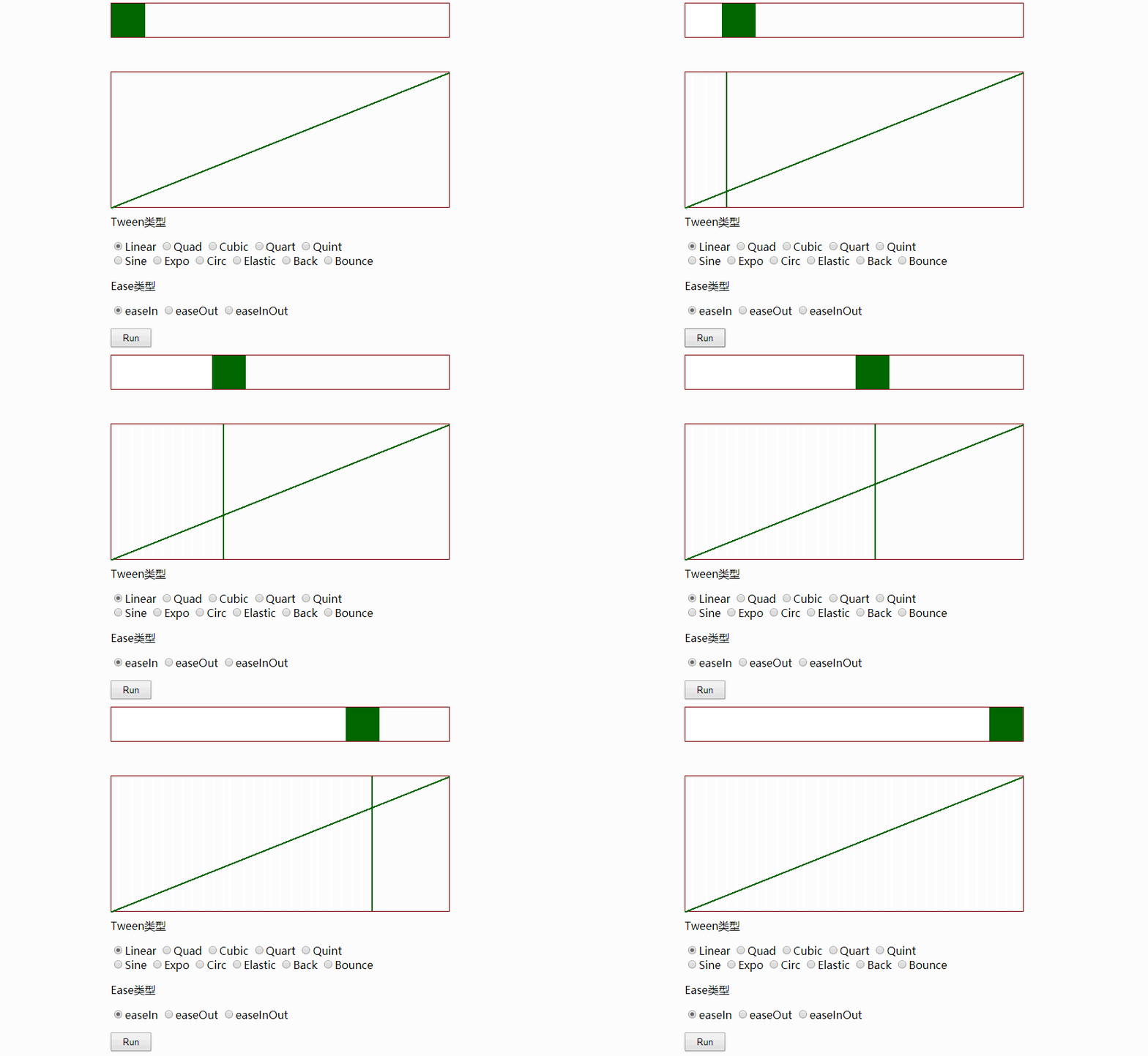
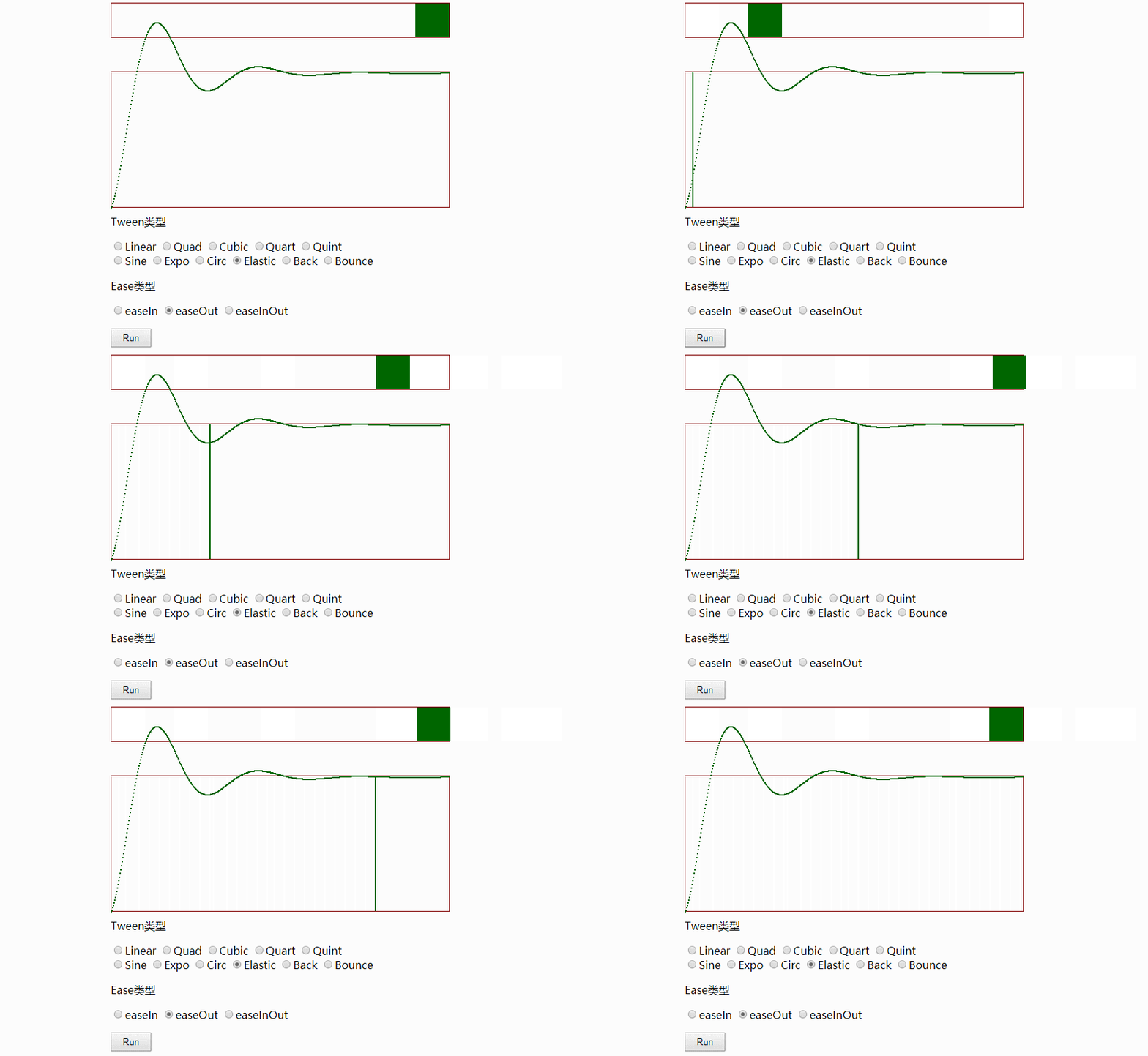
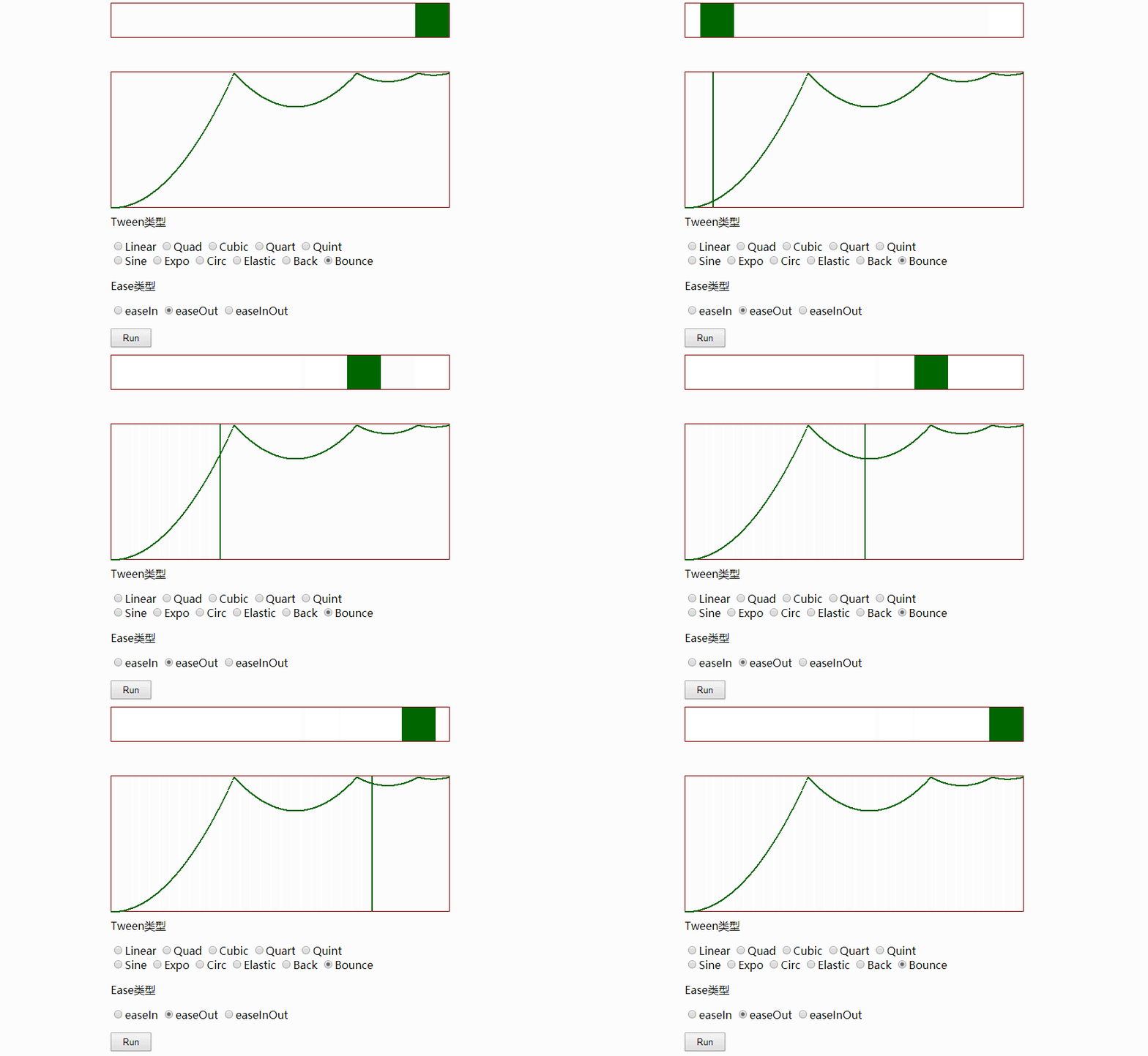
Tween算法演示(更新)
html演示效果(来源网络):
 Tween.zip
(4.5 KB, 下载次数: 12)
更新内容
【v1.1更新_2018.09.07】
1.tween参数(subject/target)支持Object对象。(共支持hash、object)
【v1.2更新_2018.09.19】
1.tween对小数处理的精度问题。
【v1.3更新_2018.09.28】
1.tween支持方法读取/更改(v/v=)。
2.修复定时器套用定时器产生的问题。
【v1.4更新_2018.10.03】
1.tween末尾传递的参数(*args)未生效的问题。
【v1.5更新_2018.10.06】
1.tween参数对象subject的检测方法支持method_missing。
【v1.6更新_2018.10.09】
1.tween修复精度。
2.tween对方法修改的bug。
3.tween同时执行多条计时,对相同对象属性修改的机制修改。
4.扩大随机的UUID。
5.优化脚本。
【v1.7更新_2018.11.14】
1.tween支持格式加强,支持嵌套。
例:timer.tween(60, sprite, {x: 10, src_rect: {width: 50}}, 'linear')
【v1.8更新_2018.11.16】
1.新增script实例方法。(将方法附加块传入函数的内部创建Fiber,使用wait.call(n)不影响主线程进行等待,下面的代码相当于一个简化版的after集合。)
- # 范例
- @timer.script{|wait|
- puts 1
- wait.call 60 # 等待60帧
- puts 2
- wait.call 60 # 等待60帧
- puts 3
- }
-
- # 上面的代码执行结果等同于下面的
- puts 1
- @timer.after(60, proc{
- puts 2
- @timer.after(60, proc{
- puts 3
- })
- })
【v1.9更新_2018.12.27】
1.every的action增加一条参数传递,用来获取执行的第几次。
例:timer.every(1, proc{|n| puts n } )
【v2.0更新_2019.01.25】
1.修改了during的作用(持续循环执行一个任务N秒,如果执行时间过长超出限制秒数则不会强制中断)。
【v2.1更新_2019.06.18】
1.修复了一个bug。
【v2.2更新_2019.09.28】
1.优化tween。
2.新增实例方法:
disposed? # 定时器是否已释放
clear # 清除计时器所有任务
【v2.35更新_2019.10.14】
1.修复cancel方法未能即时生效的问题。
2.tween的method方法中@_attr重复记录对象导致的属性变动异常问题。
【v2.36更新_2020.03.11】
1.兼容重复 dispose 导致的出错。
2.添加progress(tag)方法, 查看计时器完成进度(0~1)。
3.cancel方法支持多参数,可以传多个tag。
【v2.37更新_2020.03.13】
1.新支持:every 方法第一个参数如果是负数, 则表示第一次循环不需要等待。
【v2.38更新_2020.03.15】
1.新增类方法:
tween_ # 用来获取 tween 的单步值。
# 例:Timer.tween_(0.3, 100, 200, 'linear') # 返回 100->200 使用 linear 方法 30% 进度的值
【v2.5更新_2020.03.27】
1.使用__send__方法来替换之前的send方法调用, 避免对象自定义send方法后调用导致出错。
2.使用__id__方法来替换之前的hash方法调用, 避免对象自定义hash方法后调用导致出错。
【v2.6更新_2020.03.30】
1.cancel/progress 方法支持正则表达式。
2.update(tag=nil) 方法传入tag标签或数组,可以手动更新指定的定时器(支持正则表达式)。
3.新增实例方法:
has?(tag, include=false) 查看是否有指定任务, 如果存在则返回任务, 不存在返回 nil
tag 支持正则表达式或字符串。
include 表示是否以包含匹配(只在 tag 为字符串时有效)。
4.优化脚本。
【v2.7更新_2020.05.26】
1.tween支持传附加区块进行回调。
tween(...){|t, i, r, k, v| p "#{t}, #{i}, #{r}, #{k}, #{v}" }
# t 当前定时对象, t[:time] 即为当前帧
# i (0当前帧更新前/1对象赋值前/2对方赋值后/3当前帧更新后)
# r 操作的对象
# k 操作的属性
# v (要增加的值/增加后的值)
2.优化注释、异常错误的提示。
3.优化脚本。
【v2.8更新_2020.08.27】
1.加入 TWEEN_METHOD_ASYNCHRONOUS 常量属性,设置 tween 的方法是否异步。
2.[after/every/tween] # 该方法的[delay]参数支持整数/范围类型, every 使用范围参数每次循环都会在范围内随机。
3.tween 的 target 对象可以添加 _cb_(Proc) , 作用与 tween 的附加区块功能类似。参数为(对象, 当前帧), 会在当前属性调用完毕后调用一次 _cb_ 。
【v2.9更新_2021.01.31】
1.tween新增bezier补间方法。
需要在 tween 的 tag 参数后传入一个数组([x1, y1, x2, y2])
例:@timer.tween(10, s, t, 'bezier', nil, nil, [0,0,1,1])
@timer.tween(10, s, t, 'in-out-bezier', nil, nil, [0.42,0,1,1])
@timer.tween(10, s, t, 'in-bezier', nil, nil, [0.25,0.1,0.25,1])
@timer.tween(10, s, t, CubicBezier.new(0,0,1,1))
Bezier曲线图在线查看:https://cubic-bezier.com/
【v3.0更新_2022.01.16】
3.tween 的 target 对象可以添加 _before_(Hash) , 可以设置subject的初始属性。
3.tween 的 target 对象可以添加 _try_(Boolean) , 设置为 true 后定时任务出错后不会停止。
旧版下载链接
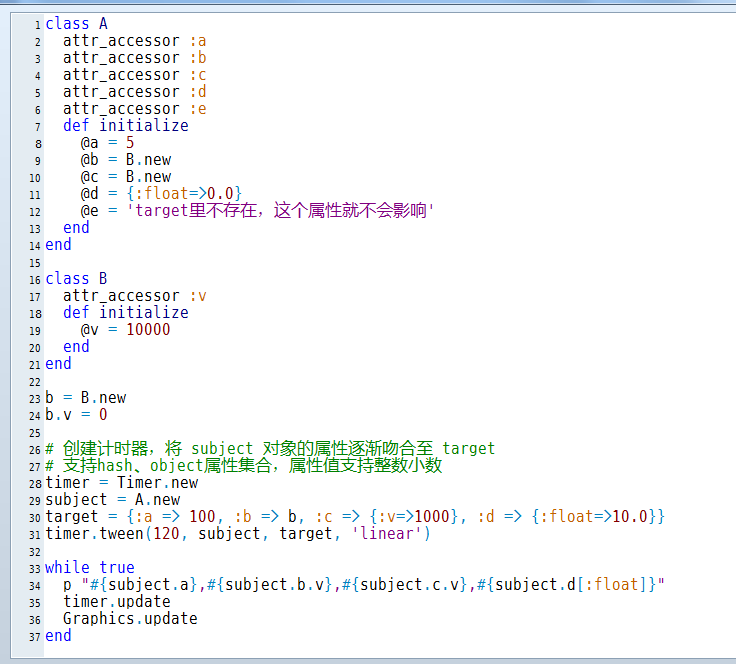
范例范例一
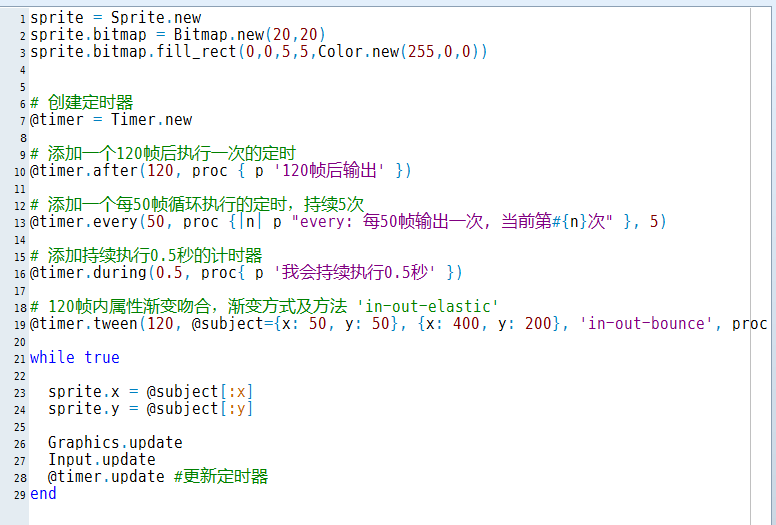
范例二
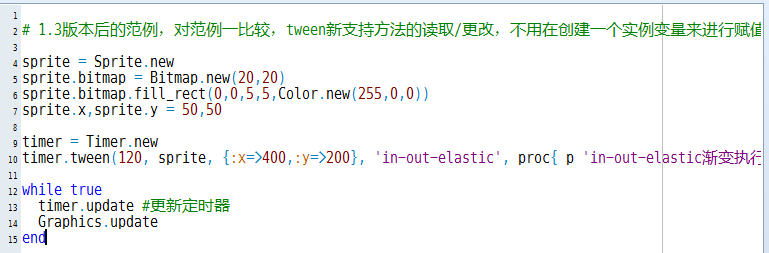
范例三
- bit = Bitmap.new(10,10).tap{|b| b.fill_rect(b.rect, Color.new(255,0,0)) }
- arr = 10.times.map{ {s: Sprite.new.tap{|s| s.bitmap = bit }, r: -1.57} }
- timer = Timer.new
- timer.every(10, proc{|i|
- t = 180
- timer.every(-t, proc{
- timer.tween(t, arr[i], {r: arr[i][:r]+Math::PI*2}, 'in-out-cubic')
- timer.every(1, proc{
- s, r = arr[i][:s], arr[i][:r]
- s.x, s.y = 272+Math.cos(r)*50, 208+Math.sin(r)*50
- }, t)
- })
- }, 10) # 创建好任务, 只需要交给 timer 的 update 来执行即可
- loop do
- Graphics.update
- timer.update
- end
使用帮助在脚本说明里面,利于执行/简化脚本、坐标/属性变动、循环执行任务、tween动画等。
范例下载:
[RM]定时器v3.0.7z
(1.42 MB, 下载次数: 280)
|
评分
-
查看全部评分
|



 写轮眼

 发表于 2018-9-2 12:30:03


 提升卡
 沉默号角
 喧嚣号角
 变色卡
 升龙剑

